Dispatch #2: Communication—How to speak Dog
If I had to describe to an alien “what is dog training?”, I would tell ole ET that it is simply learning how to communicate with a dog in a clear and effective manner in order to convey and explain to the dog what it is I want it to do.
Communication is a catch all phrase and describes all the ways in which we send signals to each other. It starts with body language to include hand commands, facial expressions, scent and of course verbal communication. To really get good at communicating with your dog you have to be familiar with how all of them work and be aware that you are always sending some sort of signal to your dog, even when you’re not directly engaging with it.
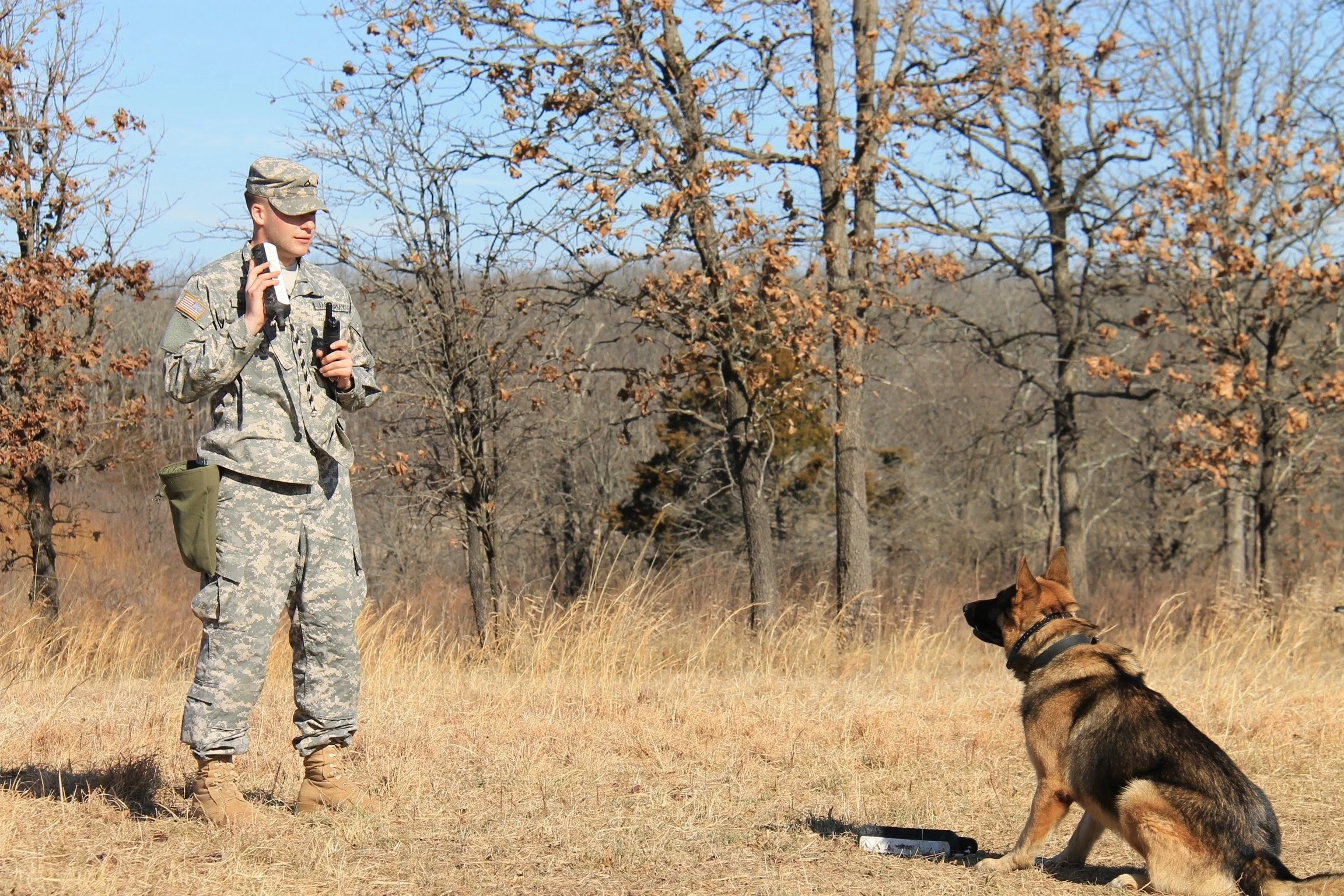
Private First Class Walther, U.S. Army builds drive for training bumpers in his Military Working Dog Jack V472 while attending the Patrol Explosive Detector Dog Enhanced (PEDD-E) course in Fort Leonard Wood, Missouri, February 2017. (Photo by Private First Class Ridge, U.S. Army)
Let’s lay the groundwork for communication with classical conditioning. This term gets thrown around a lot in dog training and rightfully so, it’s how they learn (and so do we by the way). Ivan Pavlov (1849-1936) was the first scientist to record this phenomenon and formally analyze it. He observed that his dogs would salivate at the sound of a bell that was rung before he fed them. That sounds straight forward and probably familiar to most but it’s quite profound when you really think about it. A bell means absolutely nothing to a dog, it is what’s called a neutral stimulus, its neither positive nor negative and doesn’t trigger any sort of genetic response either. Now, over multiple repetitions of ringing the bell before feeding the dogs however, the dogs subconsciously started reacting to just the sound of the bell as if the food was already Infront of them. Their body produced an unconscious reaction that they can’t control, salivating.
When he noticed that he could attach a strong unconscious reaction to a neutral stimulus, he started experimenting with timing. He found that the “golden window” of classical conditioning happens around 1 second between the neutral stimulus and the reward (food). However, he also determined that classical conditioning can still happen with up to 30 seconds between stimuli.
Through his research, Pavlov identified four primary timing arrangements:
Delayed Conditioning: The neutral stimulus (e.g., bell) is presented and remains present until the unconditioned stimulus (e.g., food) is introduced. Pavlov found this to be the most effective method for establishing a strong association.
Trace Conditioning: The neutral stimulus is presented and ended before the food is given, leaving a "trace" interval of silence in between. Pavlov noted that while learning occurs, the longer the gap, the weaker the conditioned response.
Simultaneous Conditioning: The bell and food are presented at the exact same time. Surprisingly, Pavlov found this leads to very weak learning, as the bell doesn't act as a useful predictor of the food.
Backward Conditioning: The food is presented before the bell. Pavlov discovered this is generally ineffective; the bell becomes irrelevant because the "reward" has already arrived.
Note: Until we get into advanced topics, we will stick to Trace Conditioning as it is the most common form of conditioning we use as dog trainers, simply because it is the most feasible for us to utilize in the widest range of scenarios.
Commands/Markers (Dog Vocabulary)
Now that the groundwork is laid out, let’s explore how we use these concepts in virtually every single facet of dog training by learning what commands and markers are. If you own a dog, you are already using these even if you didn’t know it. A command is generally referred to you telling the dog what you want from it (Sit, Down, Heel), while a marker is a way of telling the dog if you like what it is doing or not (Yes, Good, No). But it is important to note that hand commands and or other auditory cues like whistles or clickers can also be conditioned as commands and or markers. Pavlov’s Bell is an excellent example of what we would consider a marker, it marks the fact that food is about to be delivered.
Contrast and Clarity
For any sort of conditioning to occur the dog must be able to perfectly differentiate the stimulus we are conditioning from the endless stimuli (distractions) in our environment like the smell of food in the kitchen or other people having conversations. Anytime you are teaching a new thing you need to minimize all the stimuli you can so the stimulus you want to condition stands out as clear as possible to the dog. The new stimulus also needs to be as consistent as possible in order to be clear to the dog. For example, you say the command “Sit” in the exact same tone at the same volume each time, it’s clear and easy for the dog to recognize the pattern and try to understand it. If you said sit in a different tone each time, the dog would likely not understand that you are sending the same signal, as something is legitimately different about it every time. The word contrast could be used interchangeably with clarity, but its most often it’s used in the context of purposefully creating a situation that stands in stark contrast to another to help the dog learn. For example, if a dog loves to tug on a toy you use to reward it with, but it will not release it. You can create contrast, to teach it to release by playing tug with the dog, moving around and even making noise and talking to it. When you want it to release you just freeze and pin the toy against your thigh taking away the dogs ability to tug and essentially taking all the fun out of it, as it is now immobile and you are no longer moving around. The dog will eventually get bored or frustrated, release the toy at which point you spring back into action and play with the dog as a reward for releasing. You created contrast by simply controlling the stimuli in the dog’s environment.
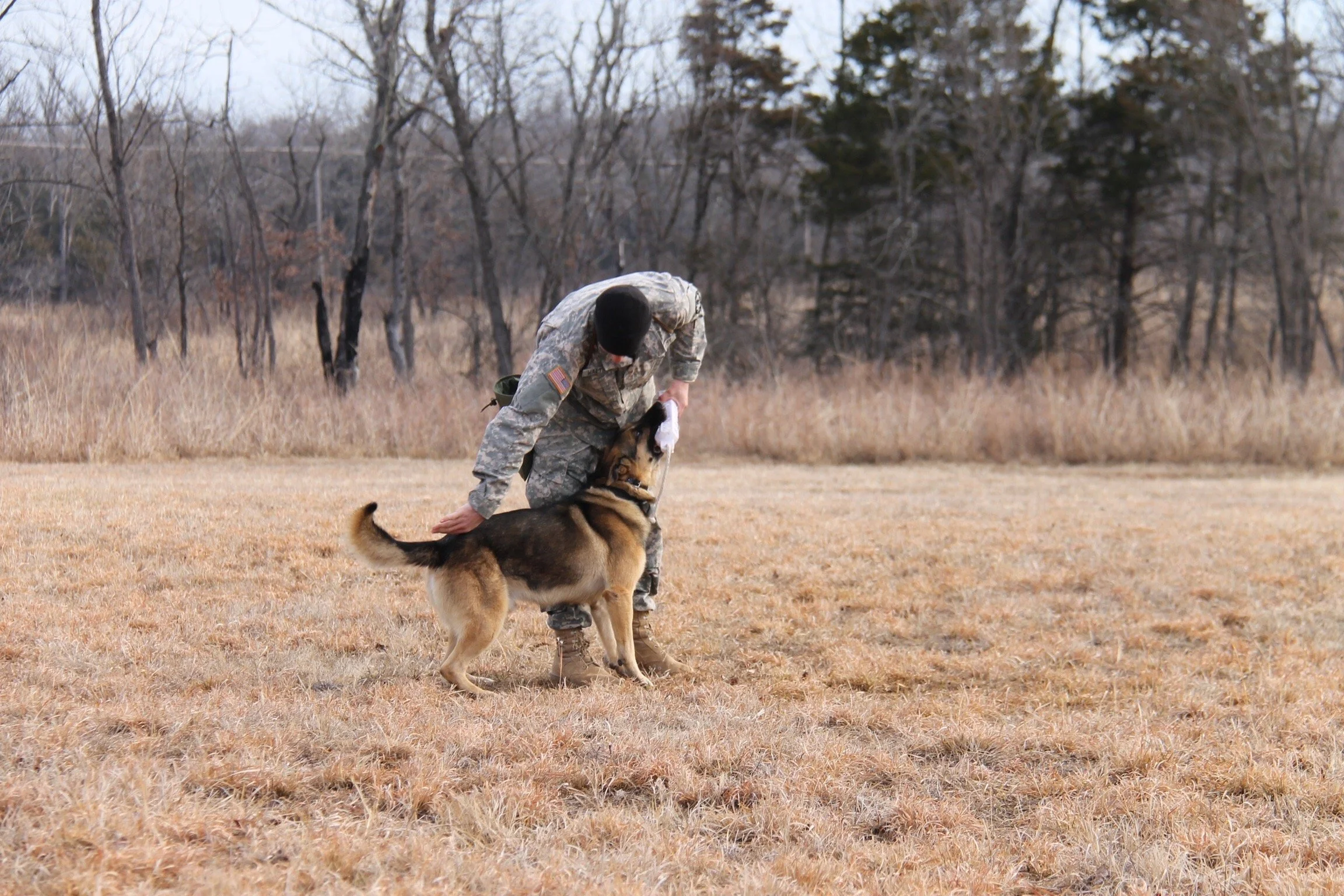
Private First Class Walther setting up a high contrast situation to be as clear as possible as he prepares to command MWD Jack V472 to release the bumper in Fort Leonard Wood, Missouri, February 2017. (Photo by private First Class Ridge, U.S. army)
Communication is a two-way street
Let’s shift gears for a moment and explore these concepts from the dog’s point of view. Don’t forget that everything mentioned in this article also applies to how the dog communicates with you, unfortunately they’re vocal cords can’t produce a spoken language as ours, so our dogs constantly send signals to us in the same way we send signals to them through body language, behavior and sometimes even barking. Our dogs never learned about Pavlov and can’t control stimuli like we can, so it takes a lot more effort on our part to truly learn the dog’s individual cues and what they mean. Misreading signs is easy to do. Smiling may look cute but usually indicates stress, yawning can mean the dog is tired or also indicate that it is severely stressed. There is no dictionary that teaches us what the dogs actions mean. While there are commonalities, each dog is an individual and acts differently just like us humans. Over time you simply must pay attention as closely as you can and learn each dog’s individual signs. Mistakes are guaranteed, even if you’re a pro, but don’t worry it gets easier with experience.
How do I use all of this with my dog?
Here's an example of how to apply everything we just learned. As a basic principle, anytime you teach something new, try to be in as sterile of an area as possible, a clean comfortable area with no distractions for the dog.
If I want to teach a dog to sit, I will start out by not feeding it in the morning and using its food instead for training throughout the day. I would begin by conditioning the marker “YES”. This will communicate to my dog that it just did exactly what I want and that it will receive a reward. I simply show the dog that I have food in my hand, let him sniff and even nudge it but not let it get the food by holding it in a closed fist. Then I will calmy but clearly say “Yes” and immediately open my fist to let the dog get some kibble. Remember say the marker first and then produce the reward, preferably within one second but certainly not simultaneously (Trace vs. Simultaneous). This is what most trainers refer to as “Mark, Move, Pay” as a reminder that you do not need to be instant, you mark, THEN you move to either grab the food or toy, THEN you give it to the dog. When it comes to this slow is smooth and smooth is fast. Now you repeat this about 10 times per session and conduct a few sessions throughout the day. By the end of the first day, you most likely turned you saying “yes” into Pavlov’s bell.
Note: It’s important to stop sessions BEFORE the dog loses interest, the session should end with the dog still wanting more. We rely on their motivation to want to interact with us, if they are tired, disinterested or bored because the sessions were too long or to frequent, we have nothing to work with. Every dog is different, its safest to end immediately if your dog starts losing interest and pick it back up later.
On the second day you start by doing the same thing a couple of times to reinforce the dogs understanding that “Yes” means food is coming. And then you simply let the dog sniff your hand as before but now move your hand slowly upwards and toward the dogs back (see illustration) until it naturally falls into a sit. Now immediately mark that behavior with a “Yes” and open your fist. Again roughly 10 iterations per sessions and multiple sessions throughout the day. By the end of the second day your dog is most likely already anticipating that when your hands starts to move upward it must sit before it can access the reward, you just classically conditioned your hand movement to indicate to the dog to sit.
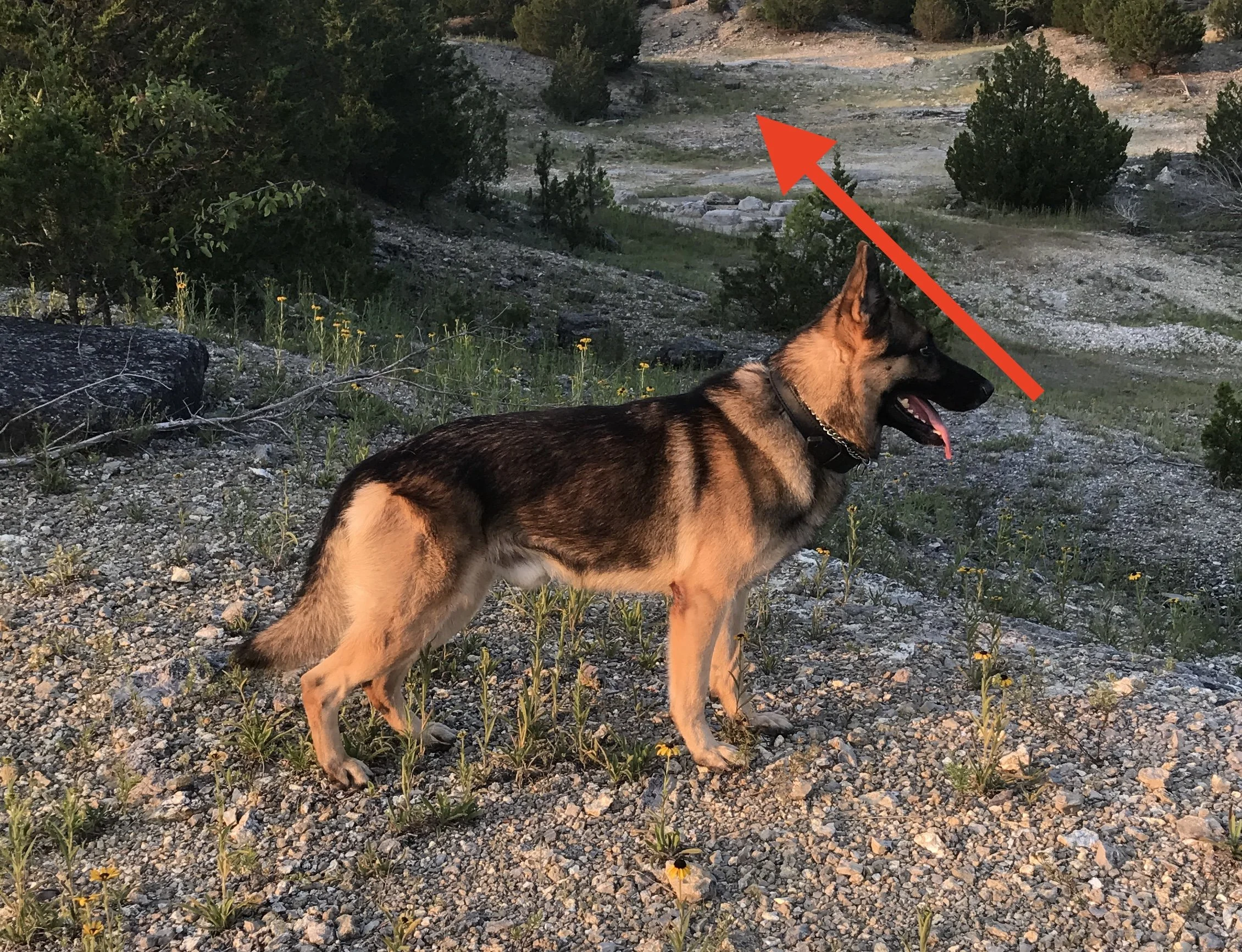
Once the dog understands that sitting unlocks the reward it will start to offer that behavior in the hope of getting you to feed it for sitting. This is when we introduce the verbal command of “Sit”. You will now calmly but clearly say “Sit” then immediately start moving your hand upwards at which point the dog will sit and you immediately mark that behavior with a “Yes”. Throughout your iterations and sessions your dog hopefully starts to anticipate that it must sit when you command it to before you even move your hand. We teach the behavior before we layer a verbal command over it because remember, both were neutral stimuli two days ago, If we had given the command “Sit” before we could reliably anticipate that the dog would do it, we would’ve likely said “Sit” while the dog just stood there confused and we could not reinforce anything. Not only would this obviously not classically condition the command with the behavior, but we would’ve actually conditioned the dog that nothing will happen when you say “Sit” making it harder for the dog to connect the dots later on.
Congratulations, you just applied classical conditioning and taught your dog a marker, a physical command of raising your hand as well as the verbal command of saying “Sit”
Closing Note
At the end of the day, dog training always comes back to communication. Every marker, command, hand signal, pause, movement, and reaction you have is part of an ongoing conversation with your dog, whether you intend it to be or not. Classical conditioning simply explains why that conversation works when it’s clear, consistent, and well timed. When you understand how dogs learn, how contrast and clarity shape behavior, and how your dog is constantly communicating back to you, training stops being about forcing outcomes and starts being about teaching understanding. The better you get at controlling and reading the signals on both sides of the leash, the easier training becomes—for you and for the dog. It’s not magic, it’s not dominance, and it’s not complicated tricks; it’s learning how to speak a language your dog already understands.
Source:
Pavlov, Ivan P. Conditioned Reflexes: An Investigation of the Physiological Activity of the Cerebral Cortex. Translated by G. V. Anrep, Oxford University Press, 1927.