
Dispatch #3: Stability “Stay”
The Definition of Stability
Stability is a dog’s ability to continue a task you commanded it to do without further input from you and while being unaffected by distracting stimuli. So, when I tell my dog to “Down” in the grass in my front yard while I mow the lawn, it should stay in that position until I either release it or tell it to do something else. It should continue to calmly lay down even if cars and bikes are driving by, while kids are playing soccer in the next-door neighbor’s front yard and folks are walking their barking leash-pulling dogs past my yard as well. This concept not only applies to basic obedience but also to active tasks the dog has to continue to perform under various conditions, like scent detection for working and hunting dogs. Reliably continuing a behavior that the dog was commanded to perform unless commanded otherwise. That is stability.
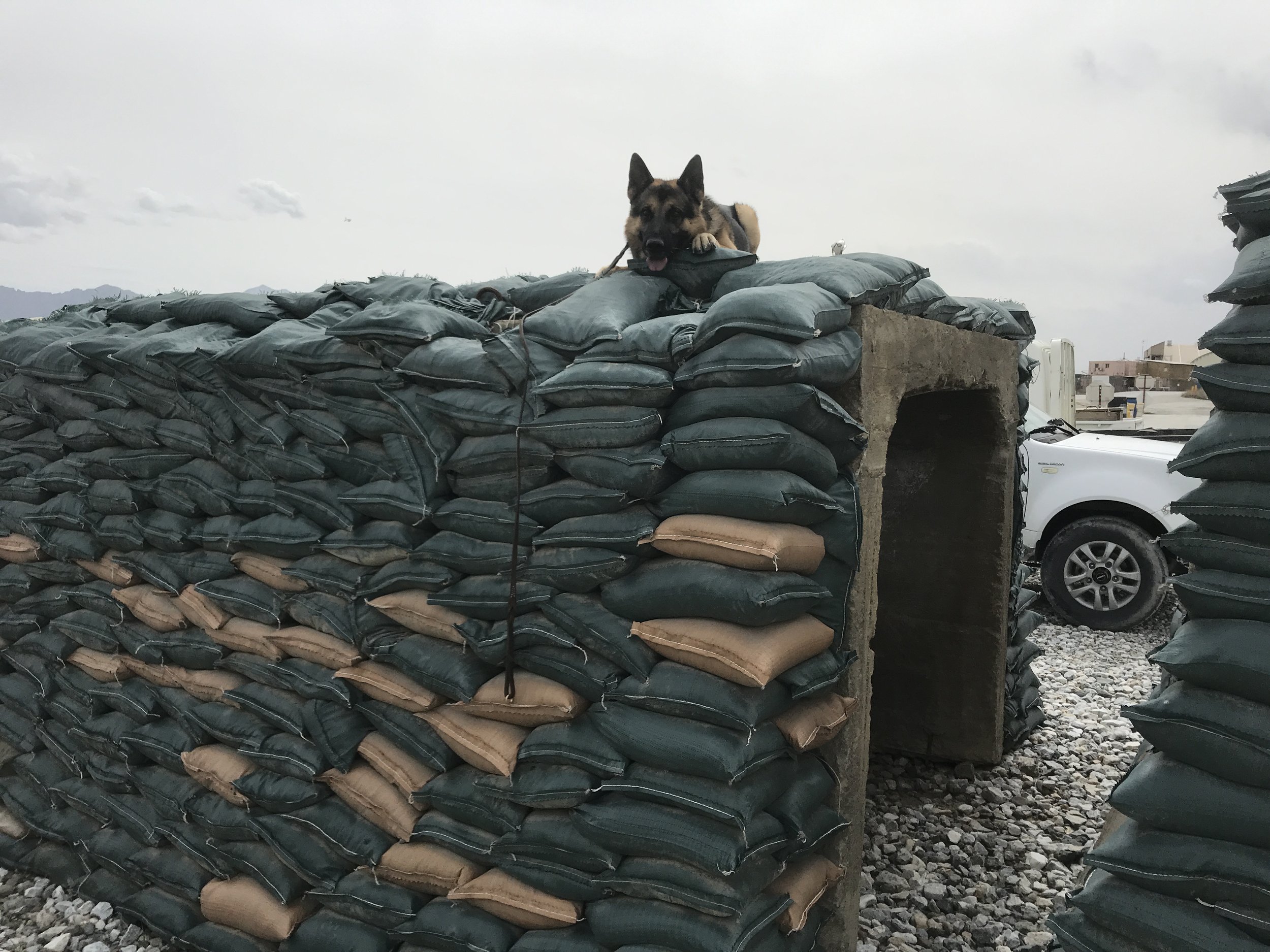
Military Working Dog Jack V472 demonstrated stability in an uncomfortable down position on top of a bunker in Bagram, Afghanistan, in 2018. (Photo by Specialist Justin Walther, U.S. Army)
This Dispatch will explain how we get to that point and what to avoid in training, while utilizing the concepts covered in Dispatch #2. There, we covered how dogs learn and what the concept of clarity during dog training is, stability is simply the result of those things if applied correctly. Once you taught your dog the basic markers and a command, it’s time to advance. Instead of rewarding the dog immediately every time it does what you commanded (fixed reward schedule), you start waiting a few seconds and or introduce a new stimulus like a noisy area to continuously add to the conditions under which your dog will perform. In the industry we call that working on the “3 D’s”: Duration, Distance, and Distraction. But the overarching term for this is stability.
The Flaw of "Stay": Clarity vs. Confusion
Historically and even today most trainers rely on the command of “Stay” to work on this. They would command the dog to “Down” and then to “Stay” periodically, if they wanted the dog to remain in that position. Let’s break this down and analyze why this is not the right way to train stability. In Dispatch 2 we covered that in order to be clear and consistent, we must have defined commands and markers that have very specific and unchanging meanings. So, when I tell a dog to “Sit”, it knows that that is all it must do and nothing else until I give it another input, such as another command or a release/reward marker like “Yes”.
If I said “Stay”, what new information am I giving to the dog? To stay seated? What if I told it to “Stay” while in a “Down”—does “Stay” now mean to continue laying down? How did we condition “Stay”? If stay means continue what you’re doing, and the dog is just walking around when you commanded “Stay” should it keep walking or freeze? At this point it should already be clear that the meaning of “Stay” is different if we say it in conjunction with different commands. Any time one word has different meanings we are running the risk of causing confusion. Even if it isn’t confusing, if I already commanded the dog to “Sit”, every additional word I say, gives the dog more to think about and increases its risk of forgetting what it was supposed to do in the first place, to “Sit”. This is no longer being clear with the dog. You are turning yourself into a neutral stimulus by continuously giving the dog a command that has never been conditioned.
Training for Success: Practical Alternatives
If I have a scatter-brained and excitable puppy that I just taught to “Sit” last week, I’m going to want to now create some duration in that position. After I tell it to “Sit” I observe it closely and realize that after just a few seconds its mind is already wandering and it’s about to get up to figure out why it didn’t get a treat yet. At this point it could be tempting to command it to “Stay” but the puppy has never heard this command before, it’s a neutral stimulus. Best case scenario is that this confuses the puppy so much that it remains seated and you eventually reward it. But what was the reward for—for sitting or for staying, and with which word did the puppy associate the reward? We have absolutely no way of knowing! And if we can’t predict what is being conditioned, we are not training, we are just a human that says some stuff and sometimes rewards or punishes the dog.
So what should you do? Instead of saying “Stay” when we think the dog is about to break, we use a command it already understands: “Sit”. The puppy was about to get distracted, but you gave it a very clear reminder of what it needed to be doing. Then, when you reward it, it knows exactly what for! It’s clear communication that avoids confusion. Eventually as you progress, of course you can’t continuously say “Sit” every five seconds, so at some point you must punish the dog either positively or negatively when he breaks from being seated. This will also be abundantly clear and teach the dog that if it is told to “Sit” that is what it must do until it receives further instructions, and that is how dogs become stable in the fastest, most clear and direct manner without ever saying the word “Stay”.
Technical Note: Defining Punishment
Any time the word “Punishment” is used in the Walther Report, it is used in the context of conditioning. Positive Punishment is applying any stimulus that will decrease the undesired behavior. For example, if a fully trained dog breaks the sit, you mark it and give it a tap on the nose. Negative Punishment is removing or withholding something the dog enjoys, in turn decreasing the undesired behavior. For example, if a dog is jumping on you to get your attention, you silently turn your back to take away the attention the dog wants. Check out the corresponding podcast to this dispatch if you need more clarification.
Disclaimer: This is next section is very dry and uses scientific terms, but I highly recommend sticking it out. Explaining dog training with science is what the Walther Report is all about.
The Science
Context: A team of neuroscientists conducted a series of peer reviewed experiments and studies. They proved that dogs’ brains show very similar activity to humans when they are exposed to positive or neutral stimuli. To prove this, they had to have un-sedated, unrestrained and awake dogs lay perfectly still in a specific position while inside of an MRI. They had to be un-sedated and unrestrained and not under threat of harm to ensure those factors didn’t affect the brain activities they wished to record. So, they had to train them to be highly stable inside of an MRI.
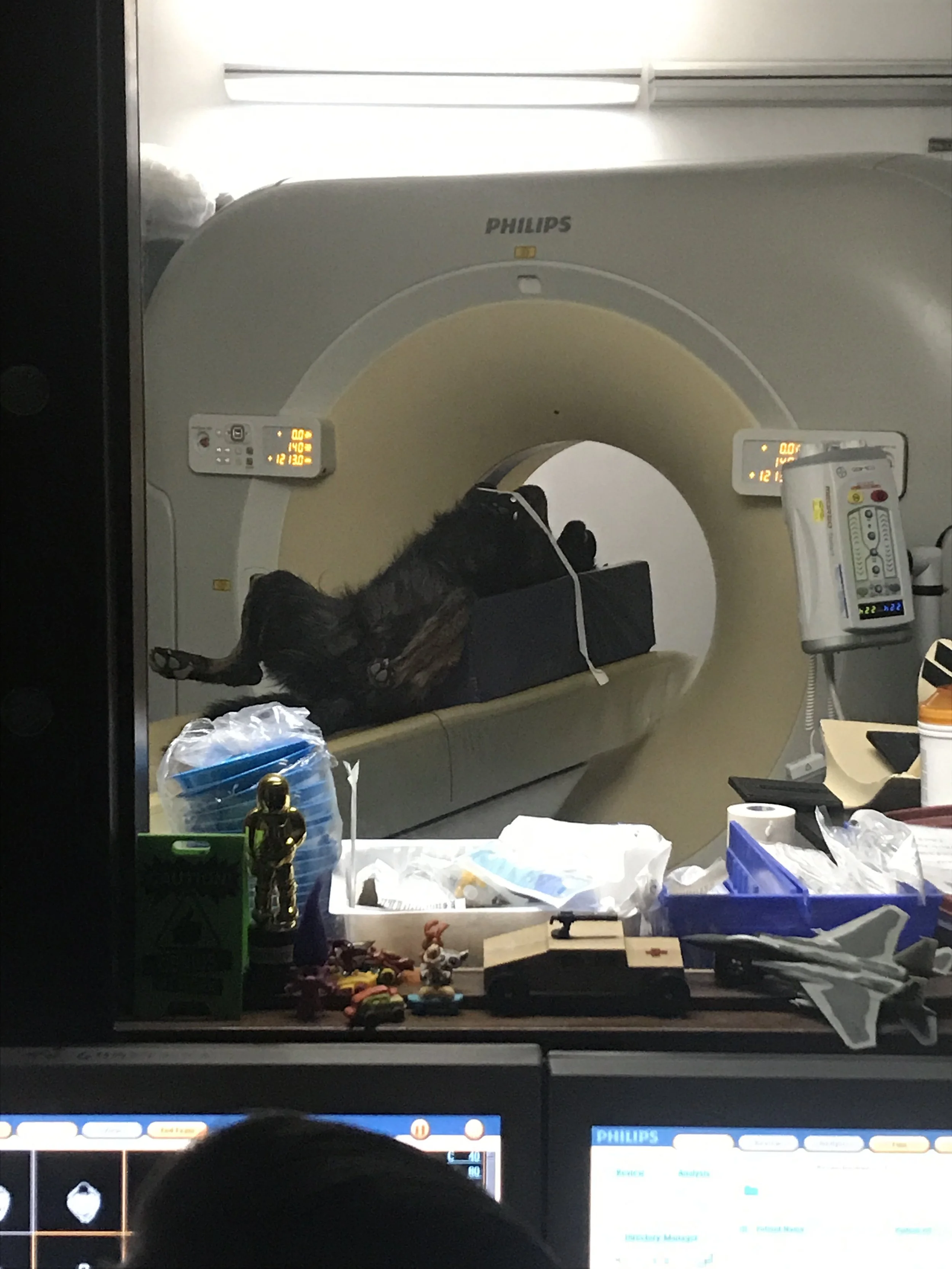
British Military Working Dog undergoing a sedated CT scan on Bagram Airbase, Afghanistan 2018. (Photo by Specialist Justin Walther, U.S. Army)
During these experiments fascinating findings were made, but equally important, concepts such as the implied stay were validated. From this research we can now confidently say that the true superiority of the implied stay simply lies in the dog himself making the decision to stay on his own. Compared to continuously giving it an unclear signal causing unnecessary brain activity. Continuously repeating “Stay” keeps the dog in a state of reactive compliance, whereas not saying “Stay” at all allows it to be in a state of active cognitive inhibition. Essentially you decrease the dog’s attention span and self-control, as it is continuously anticipating being told to “Stay”.
According to the awake-fMRI findings, successful stability is controlled by the dog’s frontal cortex—same as in humans—which acts as a neurological "brake" to inhibit motor impulses. When you continuously repeat the word "Stay," you act as an external crutch, essentially "pumping the brakes" for the dog and preventing the animal’s own prefrontal cortex from fully engaging. In contrast, training an implied stay, where the initial "Sit" or "Down" command serves as the sole communication from you to the dog, for both position and duration, forces the dog to maintain internal "top-down" or “brain to body” inhibitory control until a release marker is heard. Berns’ research shows that this self-regulated inhibition is a measurable mental skill. When we require the dog to hold the "brake" themselves, we aren't just teaching a trick, we are physically strengthening the neural pathways responsible for impulse control, physical and emotional stability.
Sources:
Cook, P. F., et al. “Neurobehavioral Evidence for Individual Differences in Canine Cognitive Control: An Awake FMRI Study.” ANIMAL COGNITION, vol. 19, no. 5, Jan. 2016, pp. 867–78. EBSCOhost
Cook, Peter F., et al. “Awake Canine FMRI Predicts Dogs’ Preference for Praise vs Food.” Social Cognitive and Affective Neuroscience, vol. 11, no. 12, Dec. 2016, pp. 1853–62. EBSCOhost
Dilks, D. D., et al. “Awake FMRI Reveals a Specialized Region in Dog Temporal Cortex for Face Processing.” PeerJ, vol. 3, no. 1115, Jan. 2015, pp. e1115–e115. EBSCOhost