
Dispatch #9: FIRST AID—The Minor Trauma Playbook
Last week, we hit the heavy stuff: massive hemorrhage and penetrating trauma. But if you're actually out there putting miles on your dogs, you’ll figure out pretty quick that catastrophic injuries are the exception. What’s actually going to bench your dog on a random Tuesday are the everyday headaches: torn pads, scratched eyes, and gnarly skin infections.
Take my Lab, Lucy. Like I mentioned, she decided to test my first aid skills last weekend while walking out in the wilderness in Kosse, Texas, by partially ripping off her right rear metatarsal pad. It wasn't an arterial bleed, sure. But a blown-out paw three miles from the truck can turn into a massive logistical nightmare if you don't jump on it immediately.
Here is the playbook for handling the minor trauma that every working dog will eventually face.
1. Paw Injuries: Pad Tears and Abrasions
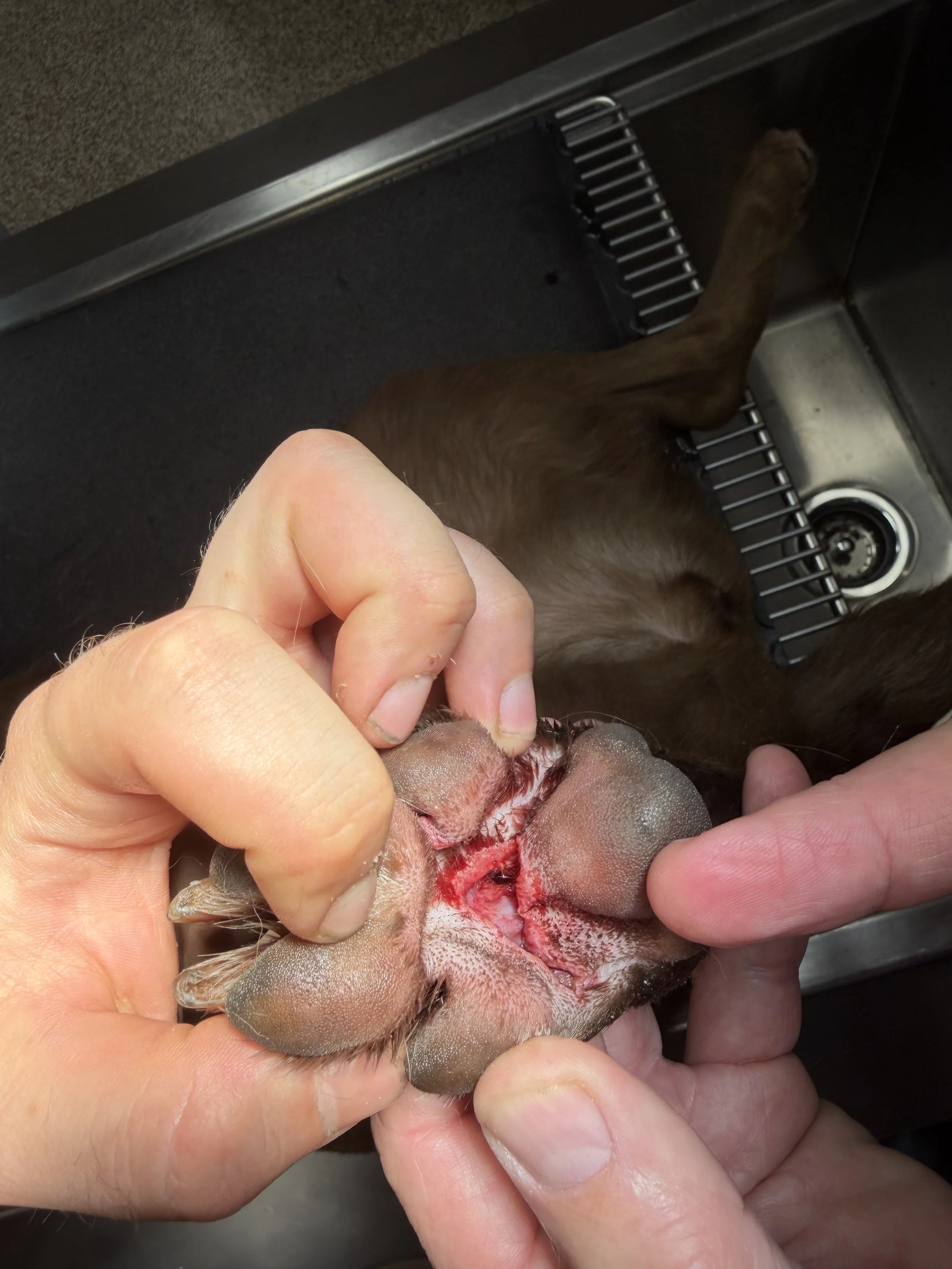
Labrador Lucy is under sedation on examination table after her rear right metatarsal pad partially separated from her foot during a walk in the woods on 28, March, 2026. The emergency veterinarian expressed gratitude after realizing ht the wun had bee lubed up prior to being wrapped in gauze and vetwrap. (Photo Justin Walther)
Whether you're pushing over scree or running them through flooded timber, your dog's paw pads take a beating. A torn pad, like Lucy’s partial avulsion, hurts like hell. Worse, it’s constantly on the ground, probably agitating the wound and making it a magnet for infection.
Paw pads are basically specialized skin over a fat cushion. They lack the dense blood supply of muscle tissue, which means they take forever to heal.
Clean and Cover: First, thoroughly rinse the wound with sterile saline or clean water to get the grit and dirt out. Before you bandage it with gauze or a non stick pad (clean tissue if necessary), generously coat the injury with a water-based sterile lubricant (or just heavily wet the pad with water if that's all you have). This is a game changer. If you pack dry gauze onto a raw pad, it can glue itself to the wound and rip the fresh clot right off when you pull the bandage away.
A massive warning here: Make sure that lube is water-based. Do NOT use oil-based ointments like Neosporin. Oil-based ointments trap heat, hinders the tissue's natural healing process, and makes it harder for the vet to clean out if the wound ends up needing sutures.
Wrap the paw tight with a cohesive bandage (like Vetrap), making sure to wrap high over the next joint to include the dewclaw so the whole thing doesn't slide off. Finally, throw a durable dog boot over it should you carry one in your truck kit. If possible don’t let them walk out on a bare bandage, so it stays clean and dry. And when you get home? Cone them. A dog's mouth is a cesspool. Licking doesn't clean the wound, it infects it.
2. Ocular Trauma: Scratched Eyes and Debris
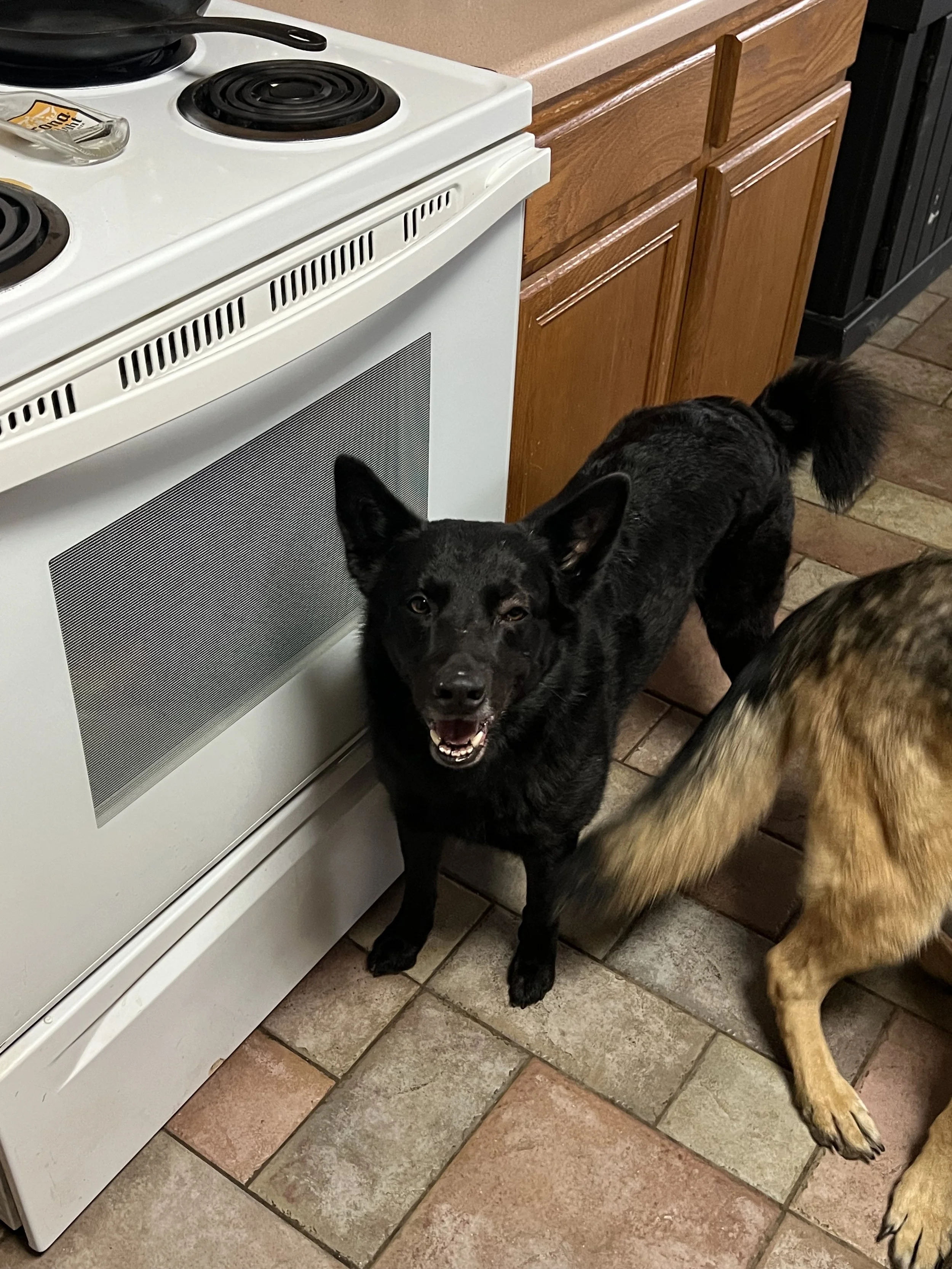
German pointy eared pointer Hiwa, smiles at the camera as he recovers from an infected eye that was caused by an undetected grass seed in San Antonio, Texas, 2023. (Photo Justin Walther)
Run a bird dog long enough and you're almost guaranteed to deal with corneal abrasions or seeds stuck in an eye. Eye injuries go south fast. A minor scratch can morph into a deep corneal ulcer in under 24 hours.
Flush and Evaluate: If your dog takes a branch to the face, grab your sterile saline and heavily pull their eyelids down gently and flush the eye from the inside corner out. Wash all the dust and grit away. If there’s actually a thorn or splinter embedded in the eyeball, do not play hero. Leave it alone. Tape a rigid cup (cut down a plastic water bottle if you have to) over the eye to protect it and get to a clinic.
The Danger of Human Meds: Never, ever use leftover human eye drops on your dog, especially anything containing steroids. If they have a scratched cornea and you hit it with a corticosteroid, the eye tissue can literally melt. You're looking at permanent blindness or losing the eye entirely. Vets use a special fluorescent dye to rule out scratches before they even think about prescribing drops. Don't guess.
3. Hot Spots: Acute Moist Dermatitis
Hot spots are fast-moving, localized bacterial infections. We see them all the time when thick-coated dogs get wet and stay wet. That moisture gets trapped against the skin and turns into a bacterial incubator.
It starts small, a bug bite or a briar scratch. The dog starts chewing on it, and within a matter of hours, you've got a bald, red, oozing mess on your hands.
Clip and Dry: The fix is clipping and drying. You have to remove the hair over and around the lesion to expose it to the air. Clip until you hit healthy skin on all sides. Next, gently clean the area with a 2% to 4% chlorhexidine solution (rubbing alcohol works to but can be very painful), then then apply an over-the-counter veterinary hydrocortisone spray to dry it out and kill the itch.
The Hydrogen Peroxide Myth: Recent data proves peroxide is cytotoxic—meaning it indiscriminately kills the healthy cells trying to repair the wound right alongside the bacteria. Stick to chlorhexidine or diluted povidone-iodine. If you catch it immediately, you can use Hydrogen Peroxide BUT ONLY ONCE, once healing has started you are essentially re-starting the healing process each time you apply peroxide again
The IFAK (Individual first aid kit) Additions for Minor Trauma
Alongside the heavy trauma gear we mapped out in Dispatch #8, your kit needs a few specific items for these everyday issues:
Sterile Saline Eye Wash: Non-negotiable for flushing eyes and blasting dirt out of lacerated pads.
Chlorhexidine Wipes or Solution: The standard for killing bacteria on scrapes and hot spots without killing healthy tissue.
Cohesive Bandage (Vetrap): It sticks to itself, not the fur. Perfect for paw and tail wraps.
Water-Based Lubricant: Individual tear-away packets are great for keeping gauze from sticking to open wounds.
Closing Note Minor injuries only stay minor if you jump on them. A torn pad left bare will get infected. A scratched eye you ignore will ulcerate. We expect a lot from our working dogs, which means their maintenance is entirely on us. Keep the kit stocked, handle the small stuff before it sidelines your season, and trust the data.
Sources:
Campbell, Bonnie G. "Dressings, Bandages, and Splints for Wound Management in Dogs and Cats." Veterinary Clinics of North America: Small Animal Practice, vol. 36, no. 4, 2006, pp. 759-791.
Hindley, K. E., et al. "A Retrospective Study of Corneal Melting in Dogs and Cats." Veterinary Ophthalmology, vol. 19, no. 5, 2016, pp. 400-406.
Lineaweaver, W., et al. "Topical Antimicrobial Toxicity." Archives of Surgery, vol. 120, no. 3, 1985, pp. 267-270.
Sanchez, Isis R., et al. "Effects of Chlorhexidine Diacetate and Povidone-Iodine on Wound Healing in Dogs." Veterinary Surgery, vol. 17, no. 6, 1988, pp. 291-295.