
Dispatch #8: FIRST AID—Stop the Bleed
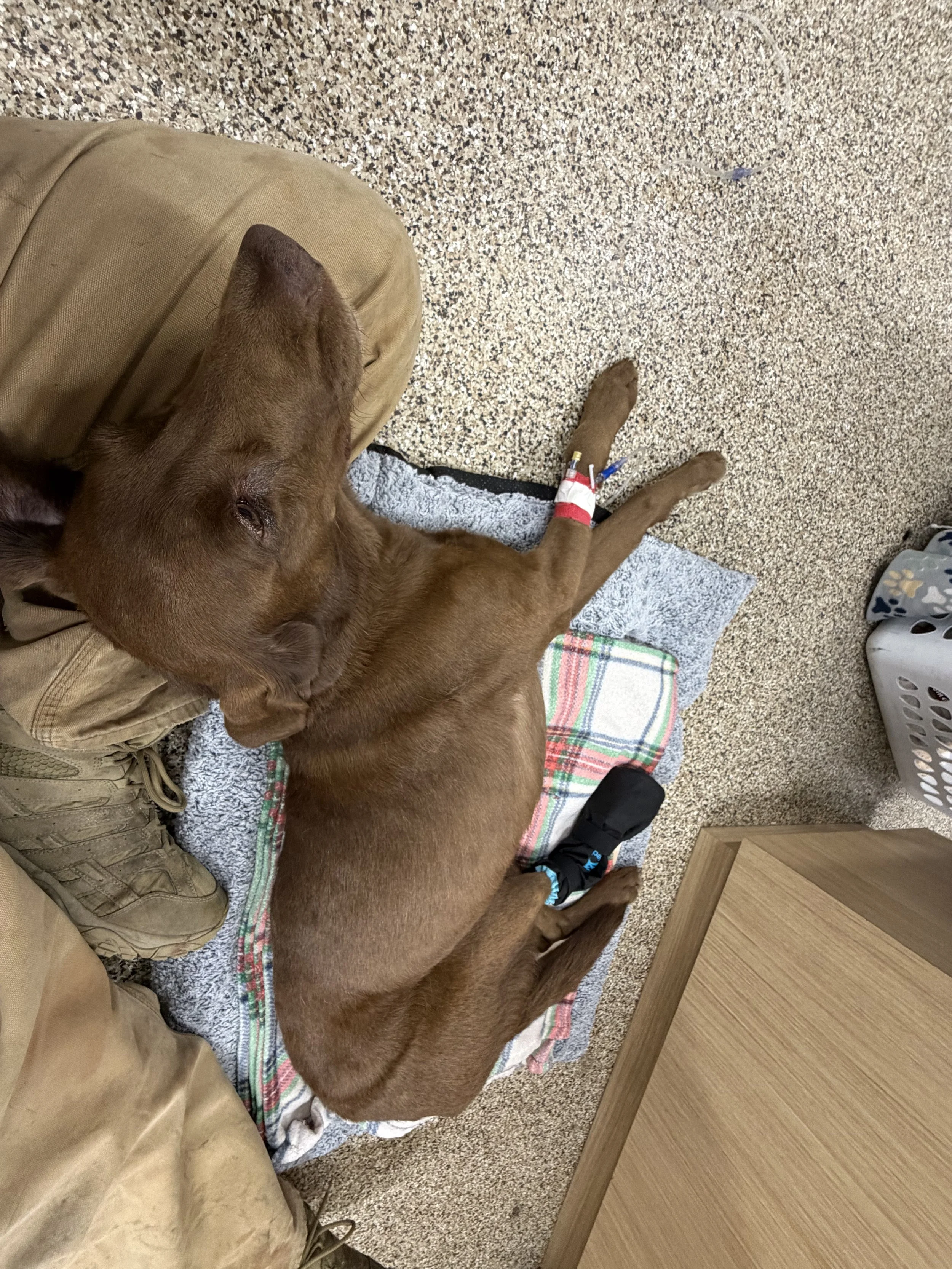
KOSSE, Texas, March 21, 2026 — Lucy, a 7-year old Labrador retriever, rests her head against her handler’s leg on blankets after receiving emergency care on Saturday, March 21, 2026. Lucy partially tore the metatarsal pad on her right rear paw while on a walk earlier in the day. (Photo by Justin Walther)
Last week, my Labrador, Lucy, decided that she wanted to test whether I was still proficient in first aid. Lucky for her, I was, and lucky for you, it caused me to want to turn it into a dispatch series. This will be purposely brief and fact-sheet-like in order for them to be easy to reference. The podcast will provide more nuance and personal real-world examples, so please go give it a listen by clicking the button above.
Now, let’s get into the first dispatch of the series. It is simple: STOP THE BLEED.
Hemorrhage Control for Lacerations
One of the most preventable causes of death in working dogs and pets is massive hemorrhage (severe loss of blood). This is unfortunate because it is arguably one of the simplest forms of first aid from a skills perspective; most people just don’t know what to do. Let’s look into the two primary types of hemorrhage control in first aid.
1. Tourniquets
Tourniquets function the same on dogs as they do on humans. It is a string or rope of sorts that is wound so tightly around a limb ABOVE the injury to cut off all blood flow and stop the bleed. There is one crucial difference: not all styles of tourniquets work on dogs.
The Data: Standard human windlass tourniquets (like the C-A-T or SOFTT-W) are designed for cylindrical human limbs. A dog’s limb is anatomically tapered (cone-shaped).
The Reality: Standard windlass designs fail on tapered limbs. A landmark evaluation published in the Journal of Special Operations Medicine tested these exact devices on canine hind extremities. The researchers found that 100% of rigid windlass tourniquets slipped distally and completely failed to maintain arterial occlusion once the limb was moved. Because of this data, K9 Tactical Combat Casualty Care (TCCC) guidelines explicitly state human windlass tourniquets should NOT be used as a first-line therapy for dogs.
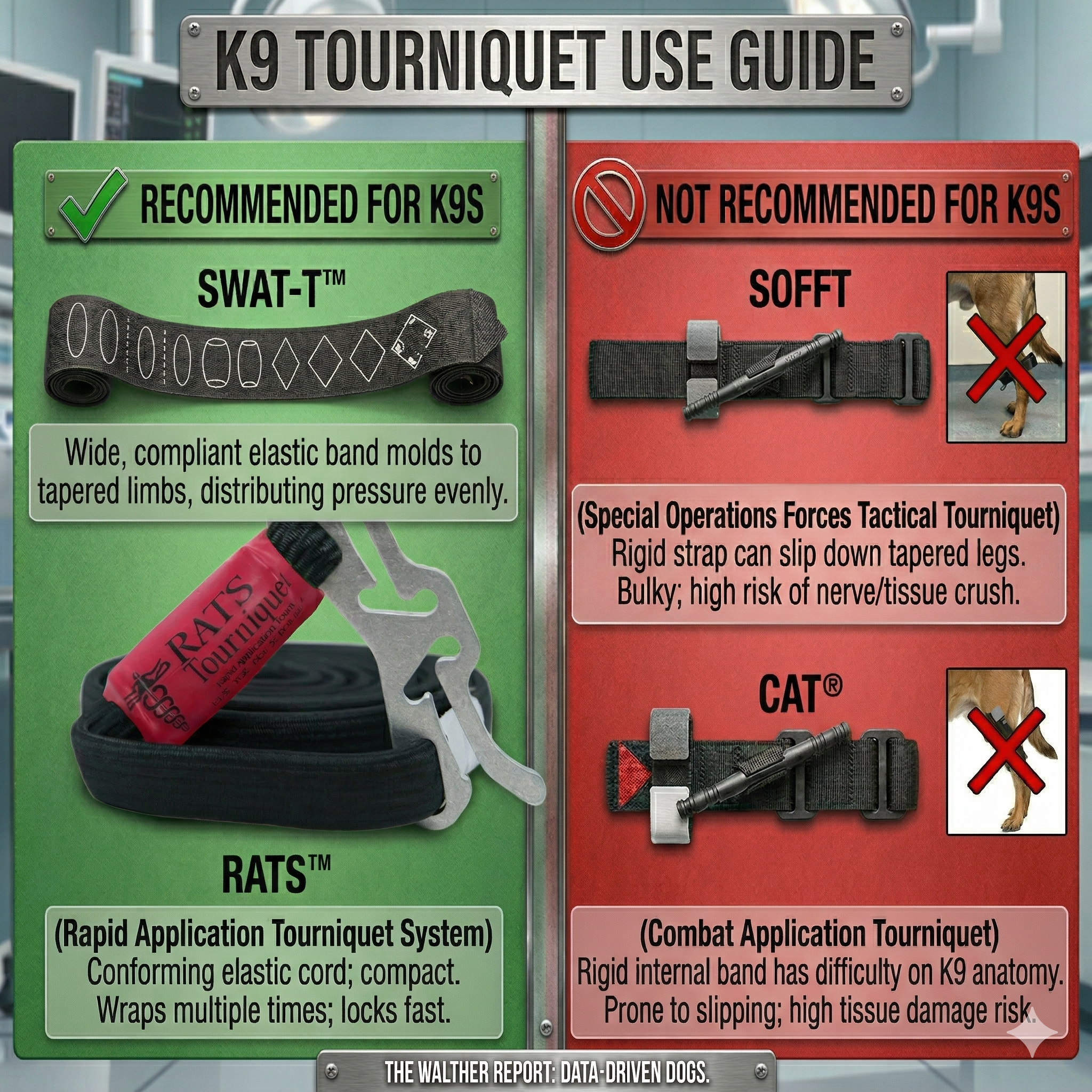
The Solution: If a tourniquet is absolutely necessary, you must use a stretchable, elastic tourniquet such as the SWAT-T, RATS, or the TacMed K9 Tourniquet (see illustrations). The wide, elastic design molds to the tapered limb and locks into place.
2. Packing and Pressure
Because dogs have significantly lower muscle mass in their lower extremities compared to humans, direct pressure is highly effective.
Direct Pressure: Apply firm, manual pressure directly over the laceration.
Wound Packing: For deep lacerations or junctional wounds (where the leg meets the torso), pack the wound cavity entirely.
Hemostatic Agents: The K9 TCCC hemostatic dressing of choice is a kaolin-impregnated bandage (e.g., Combat Gauze) or chitosan dressings (e.g., Celox, ChitoGauze).
The 3-Minute Rule: Once packed with a hemostatic agent, you must hold uninterrupted, direct manual pressure for a minimum of 3 minutes before applying a pressure bandage over the top.
Caution: Never pack a chest or abdominal wound. Packing a chest wound can collapse a lung, and packing an abdominal cavity can cause catastrophic bowel damage.
The Walther Report IFAK Recommendations
The Walther Report recommends three primary first aid items to always have on hand: compressed and sterile gauze for wound packing, as well as anything that can be used as a pressure bandage and a tourniquet.
as far as Gauze goes, the above mentioned brands like QuikClot or Combat Gauze have additives that can help to stop the bleed faster, but according to multiple special operations medics from the Tactical Veterinary Group, it is not going to make a measurable difference compared to regular gauze. What really matters is the volume and pressure of the gauze. Carry at least two compressed packets everywhere; they do not weigh enough to be noticeable and can make all the difference.
Additionally, always carry one of the dog-approved tourniquets literally anywhere you go, especially because unlike C-A-T and SOFTT tourniquets, they work on both humans AND dogs. Keep one in every vehicle, hunting vest, and hiking pack. They are quite cheap, available on Amazon, weigh virtually nothing, and hardly take up any space. It’s a very low-effort investment that may save your dog's, your own, or a loved one’s life.
Now, let’s talk about how to manage some other injuries that may not be as frequently thought of but can be equally life-threatening.
Punctures & Impalements: The Iceberg Effect
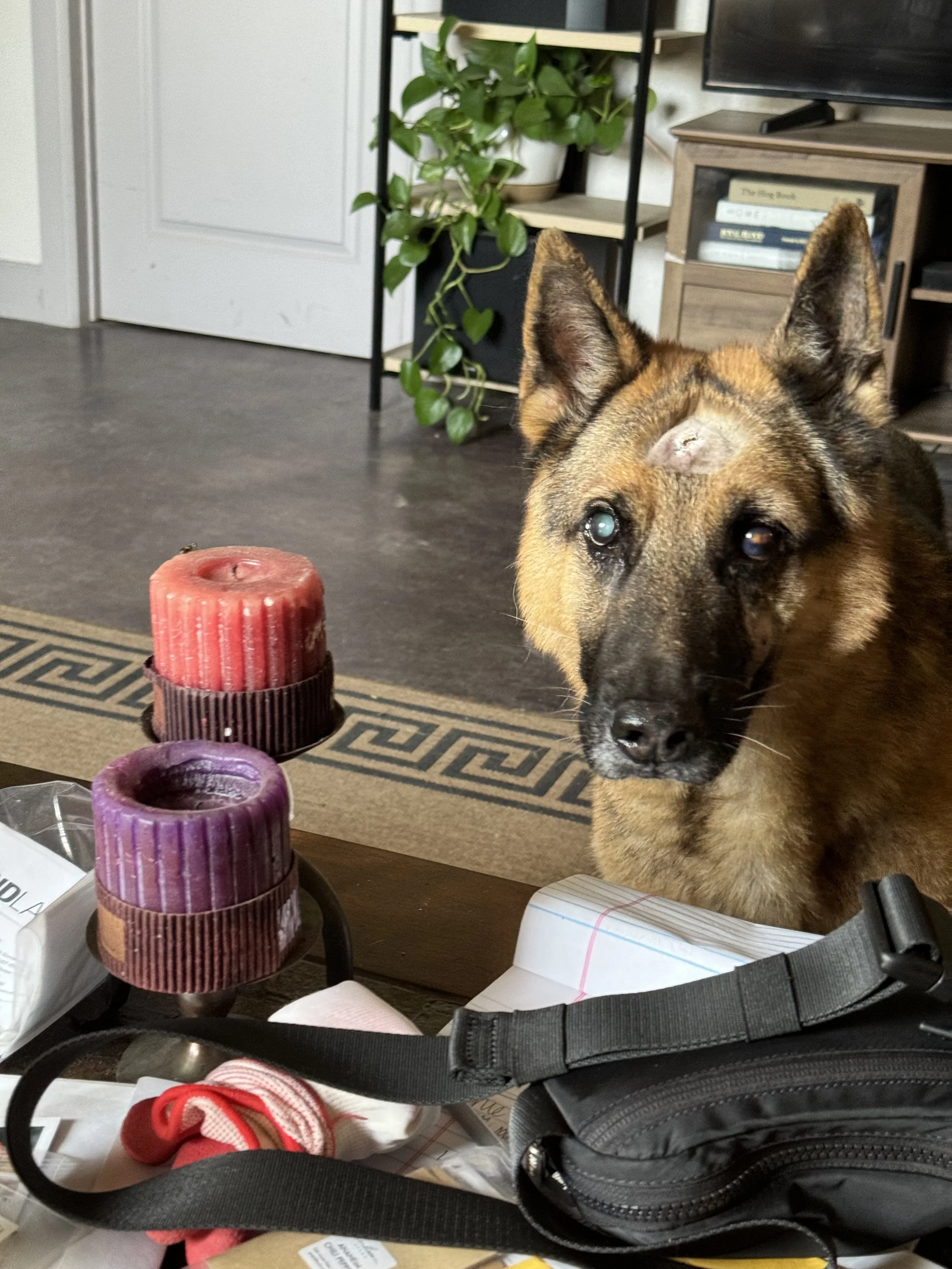
A partially healed puncture wound is visible on the head of retired Military Working Dog Jack V472 in Kosse, Texas. Jack, who is blind due to degenerative retina disease, sustained the injury during a dog fight in the spring of 2024. Blindness was partially responsible for the situation leading up to the dog fight. (Photo by Justin Walther)
Punctures are possibly the most common injuries in retrievers, especially while duck hunting. There is an unlimited number of sharp sticks under the water that we cannot see. Even in other scenarios, whether from a dog bite, a feral hog tusk, or a stick in the woods, these are the most deceptive and commonly underestimated injuries a dog can sustain.
The Anatomy of a Puncture: Canines have incredibly loose skin compared to humans (a biological defense mechanism). When a dog is bitten or impaled, the skin is pulled violently before the object breaks through.
The Iceberg Effect: A half-inch puncture hole on the surface often hides massive tissue tearing, crushing forces, and structural dead space underneath the skin. A comprehensive retrospective study published in the Journal of Veterinary Emergency and Critical Care analyzed penetrating trauma and bite wounds in canines, revealing that the vast majority of these unseen dead spaces are immediately inoculated with multiple bacterial strains, predominantly Pasteurella multocida. The researchers concluded that superficial flushing is statistically ineffective at preventing deep-tissue necrosis, making severe infection almost guaranteed without surgical veterinary debridement.
How to Handle Impalements (Sticks, Rebar, Arrows)
If your dog is impaled by a foreign object, the protocol is strictly hands-off regarding the object itself.
Do NOT Remove the Object: The stick or arrow may be actively plugging a severed artery. Pulling it out removes the plug and can cause fatal exsanguination within seconds.
Immobilize: Keep the dog as still as possible to prevent the object from acting like a lever inside the body and shredding internal organs.
Trim if Necessary: If the object is too long for transport, carefully cut it down to leave 3 to 6 inches protruding, ensuring you do not twist or manipulate the embedded portion while cutting.
Sucking Chest Wounds: If the puncture is in the thoracic cavity (chest) and you hear a hissing or bubbling sound, air is entering the chest cavity and will collapse the lung. Wipe away the blood and immediately apply a vented chest seal (or plastic wrap sealed with petroleum jelly) to close the defect.
Improvised Seals: The object here is to simply seal the chest cavity from outside air without applying so much pressure that the pressure itself prevents the dog from breathing. Especially in longer-haired dogs, you may have to think outside the box. Any sort of plastic wrap, tarps, rain jackets, duct tape, etc., can be used. You may get a better seal if you thoroughly wet down the fur around it with whatever you have. Do not worry about anything being sterile in this case; infections can be treated later, suffocation cannot.
Don't flush deep wounds: While superficial scrapes can be rinsed, pouring water or harsh antiseptics into a deep puncture or massive laceration flushes environmental bacteria deeper into the tissue tract. Control the bleed, wrap it, and transport.
Closing Note: Act, Don't Freeze
First aid is terrifying whenever you have to administer it. Nothing will prepare you better than taking a dedicated trauma first aid course like those offered by the Tactical Veterinary Group and then routinely running through scenarios in your head and continuing to practice.
But even then, when it’s your first time in such a situation, you simply have to do what you can with what you got. Remember:
The best thing you can do is apply perfect first aid and stop the bleed, then immediatly seek emergency care ASAP.
The second best thing you can do is apply imperfect first aid that may still slow down bleeding and transport ASAP.
The WORST thing you can do is nothing, or be scared to attempt to stop the bleed and choose to drive to the vet.
If your dog is actively bleeding out, chances are it will not make it to the vet alive if you do not attempt to stop the bleed first.
YOU MUST ATTEMPT TO STOP LIFE-THREATENING BLEEDING BEFORE YOU TRANSPORT THE DOG TO THE EMERGENCY ROOM. THE VETERINARIAN CANNOT HELP A DEAD DOG.
Sources:
Ateca, Laura B., et al. "Organ Dysfunction and Mortality Risk Factors in Severe Canine Bite Wound Trauma." Journal of Veterinary Emergency and Critical Care, vol. 24, no. 6, 2014, pp. 705-714.
Committee for Tactical Emergency Casualty Care. "K9 Tactical Emergency Casualty Care (K9-TECC) Guidelines." Special Operations Medical Association, 2016.
Joint Trauma System. "Canine Tactical Combat Casualty Care (K9TCCC) Guidelines for Veterinary and Medical Personnel." Department of Defense Center of Excellence for Trauma, 1 May 2023.
Palmer, Lee E., et al. "The Operational Canine and K9 Tactical Emergency Casualty Care Initiative." Journal of Special Operations Medicine, vol. 15, no. 3, 2015, pp. 32-38.