
Dispatch #6: Ethno-Cynology—the Original Partnership
From Apex Predator to Biotechnology
In Dispatch #2 I said that if I had to describe to an alien “what is dog training?”, I would tell ole ET that it is simply learning how to communicate with a dog in a clear and effective manner in order to convey and explain to the dog what it is I want it to do.
I realized after publishing that article that before we can even talk about the “how” of communication, we have to talk about the “who” and the “why.” This is the first piece in a deep dive into Ethno-Cynology—the study of dogs within human cultural, archaeological, and evolutionary contexts.
We need to start by acknowledging just how profoundly weird and unique this relationship is. There is no other animal on this planet that has been part of our social fabric for as long as the dog. According to genetic divergence studies published in journals like Science and Nature (such as the 2015 Skoglund et al. study on the Taimyr wolf), dogs diverged from wild wolves and began their domestication journey anywhere from 20,000 to 30,000 years ago. To put that in perspective, archaeological evidence from the Fertile Crescent shows we domesticated livestock like sheep around 10,000 BCE. Horse domestication, traced to the Botai culture in the Eurasian Steppe, didn't happen until roughly 3500 BCE. That means we had dogs a full 10,000 years before we figured out how to pen up sheep, and at least 15,000 to 17,000 years before we ever threw a leg over a horse. We were sleeping next to canines while we were still hunting mammoths with stone tips, let that sink in. Dogs are and undeniably have been “Mans best friend.”
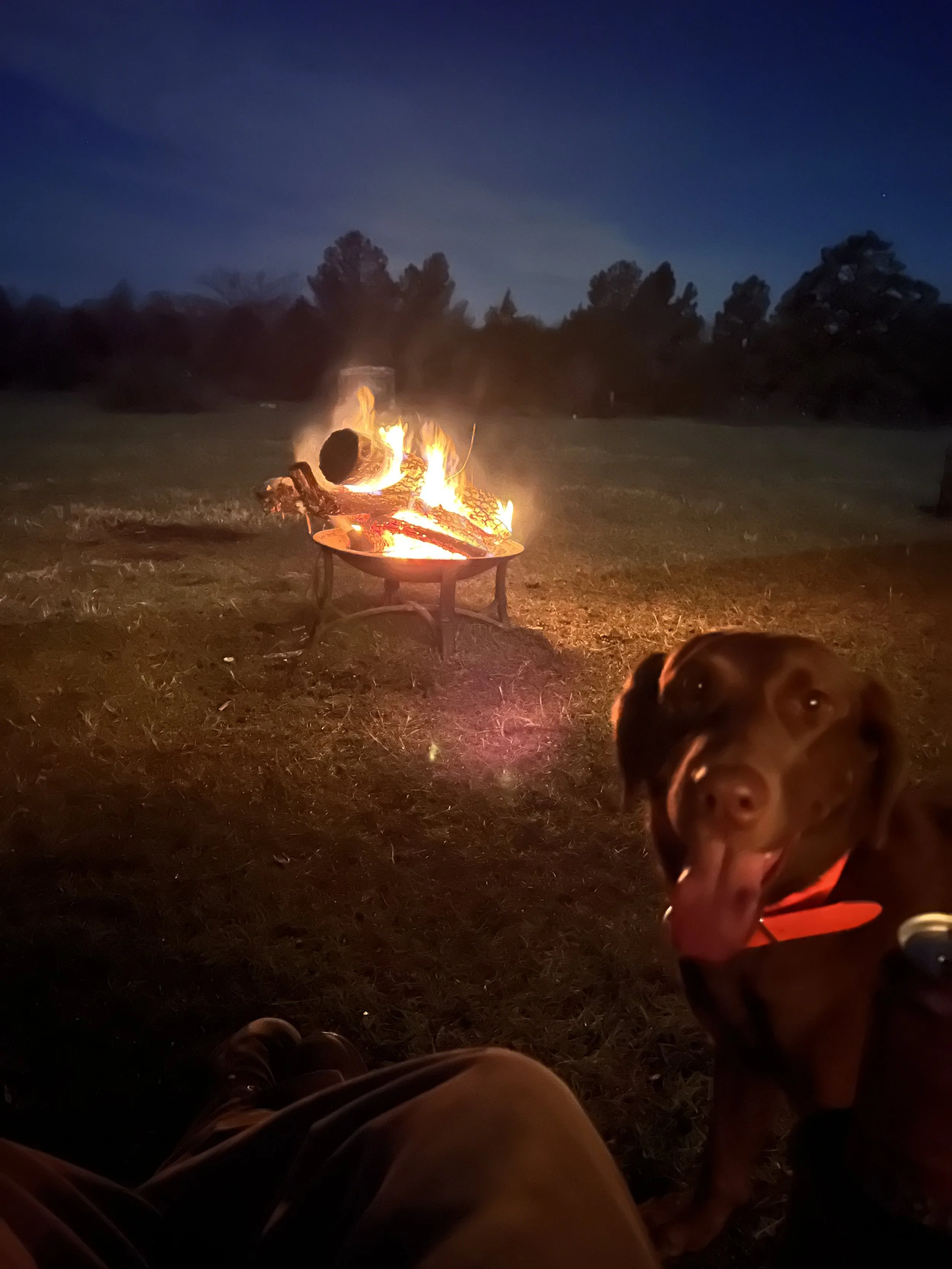
Because dogs are so unique among literally all other domesticated animals, an understanding of genetics is the absolute, non-negotiable key to training dogs today. We aren’t working with a blank slate, we are working with the most successful piece of biotechnology in human history. We didn’t just find dogs, we “genetically coded” them over tens of thousands of years to be biological precision tools, extensions of our own will used for hunting, hauling, herding, protection and more. This means that while there is a universal "dog" language we all need to speak, as outlined in Dispatch#2, the 10,000 years of specific genetic selection we've done during the Neolithic period means we must treat breeds differently. You can’t run Border Collie software on Great Dane hardware and expect it to work.
The “Alpha” Myth: A Dangerously Flawed Operating System
Before we can look at how we built the dog, we have to clear out the junk data that’s been clogging up the industry for decades. A vast portion of "traditional" training is built on the “Alpha Male” concept. We’ve all seen the shows where someone claims you have to “dominate” your dog because that’s what wolves do. They talk about “Alpha Rolls” and physical dominance as if it’s a biological requirement.
Here’s the reality: The “Alpha” foundation is a lie based on bad science.
The concept stems directly from animal behaviorist Rudolph Schenkel’s 1947 paper, Expression Studies on Wolves. As modern reviewers note, Schenkel took wolves from different zoos, total strangers to one another, and forced them into a single confined enclosure at the Basel Zoo in Switzerland. What he saw was a violent struggle for rank. But that’s not how wolves live in the wild, that’s how they live in a prison yard.
In their natural state, wild wolf packs are nuclear families. The leaders are simply the “parents,” and the followers are their offspring. There is no violent struggle for the throne, there is a cooperative family unit built on shared survival. Dr. L. David Mech, the world’s leading wolf biologist who originally popularized the term “Alpha” in his 1970 book The Wolf, formally retracted the concept in his watershed 1999 paper, Alpha Status, Dominance, and Division of Labor in Wolf Packs, published in the Canadian Journal of Zoology. After 13 summers observing wild wolves on Ellesmere Island, Mech stated that calling a wolf an alpha is “no more appropriate than referring to a human parent or a doe deer as an alpha.”
When we try to “dominate” a dog based on this myth, we aren't being “the pack leader.” We are fundamentally misunderstanding canine social biology. Dogs aren't genetically wired to fight for rank in a human household; they are wired to participate in a cooperative family structure.
The Outcast Hypothesis and Scavenger Origins: The Flight Distance Filter
So, the "Alpha" struggle is a myth, but how did we actually end up with a dog in the first place? It starts with the Outcast Hypothesis and the Scavenger Hypothesis, heavily popularized by biologists like Raymond Coppinger in his 2001 book Dogs: A Startling New Understanding of Canine Origin, Behavior & Evolution.
Wild wolf packs are highly exclusive. When resources get thin, "outcasts" are a natural phenomenon, wolves forced out of the family unit who must survive on their own. For these outcasts, survival meant finding a new niche: the human camp. These loners began hanging around the edges of our Paleolithic settlements, surviving on "trash" like discarded bones and scraps.
This transition was governed by a biological mechanism called the Flight Distance Filter. Every wild animal has a "flight distance", the specific radius at which they will turn and run when a human approaches. Wolves with higher adrenaline and more aggressive temperaments had a long flight distance but the outcasts with lower adrenaline and more docile temperaments had a shorter flight distance. They could stand to stay near the camp while we were active.
This was self-domestication at its most basic level. Over generations, the genetic "volume" of aggression and fear was turned down simply because the ones who stayed calm ate better and lived longer. The environment naturally selected for the genetics that allowed them to tolerate human presence.
The Cross-Species Adoption Theory: The Nurturing Instinct
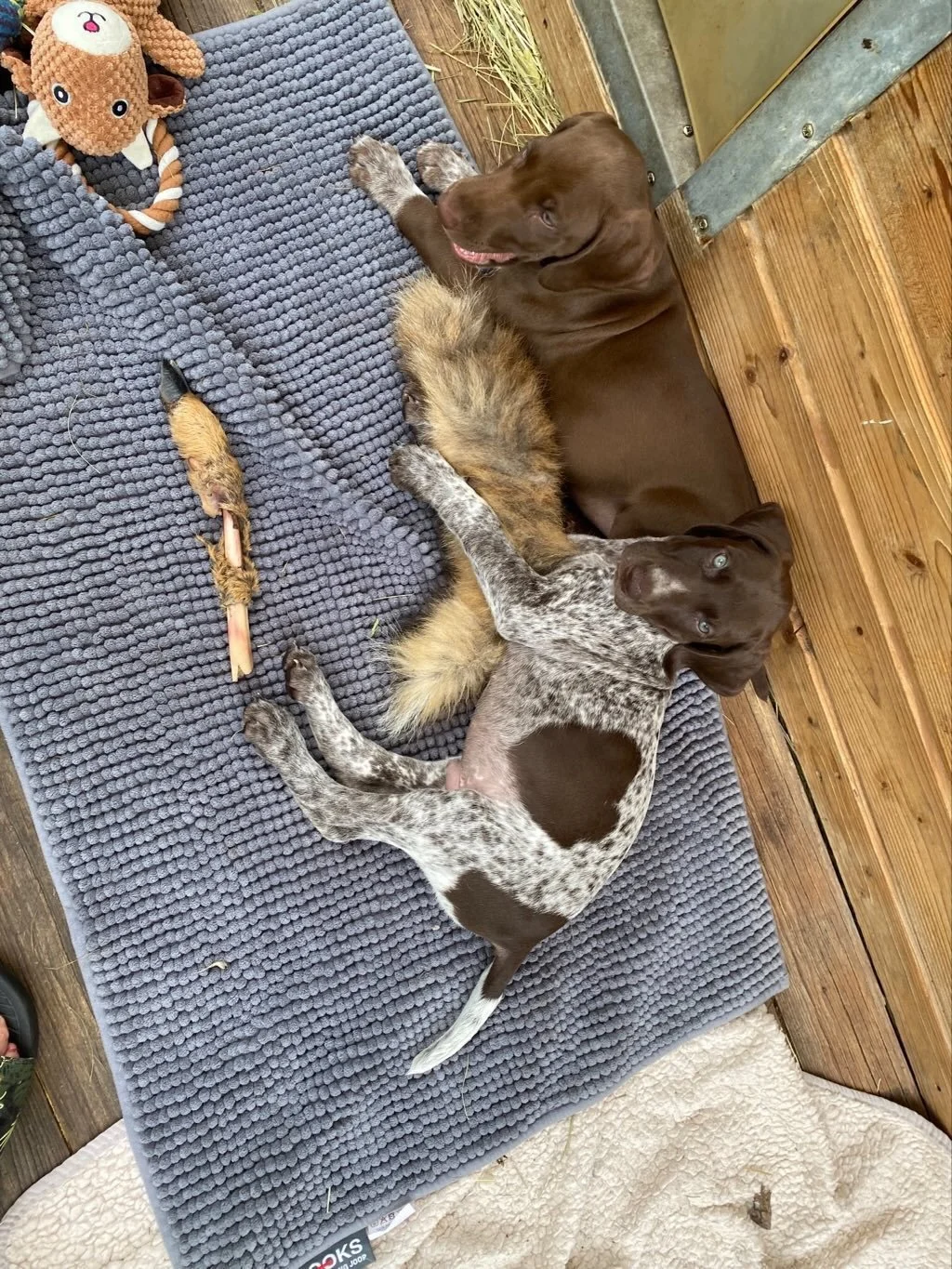
Other researchers, such as Dr. James Serpell, author of The Domestic Dog: Its Evolution, Behaviour and Interactions with People (1995), argue there was a more "active" role for humans, known as the Cross-Species Adoption Theory. This theory suggests that humans have an innate nurturing instinct that crosses species lines.
Our ancestors likely killed adult wolves for safety but found the cubs irresistible, bringing them back to the camp and raising them alongside human children. By bringing a wolf cub into a human social structure during its critical socialization period, we accidentally selected for "tameability." The pups that were too aggressive were driven off or killed, while the cooperative ones stayed. This bridges the gap between the wild wolf and the domestic dog through human social selection, ensuring that “friendliness” became a survival trait coded directly into the canine genome.
The Mutual Hunting Hypothesis: The Professional Alliance
The Mutual Hunting Hypothesis views domestication as a professional, co-evolutionary alliance. Anthropologist Pat Shipman, in her book The Invaders (2015), hypothesizes that humans and wolf-dogs formed an unprecedented predatory alliance that gave us a massive advantage over Neanderthals. We had projectile weapons and strategy, the proto-dogs (ancient dogs) had the olfactory tracking, speed, and the “bite” to hold prey at bay.
This is where the “genetic coding” for work really took off. We weren't just selecting for “nice” dogs, we were selecting for dogs that could read human signals. Studies at the Max Planck Institute for Evolutionary Anthropology have proven that domestic dogs possess a unique genetic ability to follow a human gaze and pointing gestures—a communicative trait that even our closest primate relatives, chimpanzees, struggle with. We were coding the hardware for communication long before the concept of “training” even existed.
The Russian Fox Experiment: Biology in Fast-Forward
To prove that domestication is a biological “package deal” that can happen rapidly, we look to the famous Fox Experiment. Initiated in 1959 by geneticist Dmitri Belyaev at the Institute of Cytology and Genetics in Siberia, this project sought to recreate canine domestication in real-time. Belyaev bred silver foxes, selecting them for only one trait: the lack of aggression toward humans.
The results, documented extensively by his successor Lyudmila Trut, were staggering. Within just 20 generations, the foxes were completely domesticated. But as their adrenaline and corticosteroid levels dropped, their physical appearance changed too. A phenomenon scientists call “Domestication Syndrome.” They grew floppy ears, spotted coats, and wagging tails. Behavior and genetics are inextricably linked. The very “cuteness” of the dog sitting in your living room is a biological side-effect of ancient genetic selection for a calmer nervous system.
Neolithic Specialization: Coding the Breed
While the Paleolithic era gave us the general “Domestic Dog,” the Neolithic Period (approx. 10,000 years ago) is where we began actively hacking the genetics. As humans transitioned to agriculture, we needed specialized tools.
We began “coding” dogs for specific motor patterns. As outlined by modern ethologists, we took the ancient wolf hunting sequence—Search -> Eye -> Stalk -> Chase -> Grab-bite -> Kill-bite—and selectively deleted or hypertrophied the parts we didn't want:
Salukis & Sighthounds: Selected for high-speed hunting, artificially emphasizing the “Search” and “Chase” drives in open environments.
Mastiffs & Livestock Guardians: Bred for guarding fixed assets. We emphasized sheer size and the “Grab-bite” instinct but genetically suppressed the final “Kill-bite” so they wouldn't slaughter the flocks they were meant to protect.
Border Collies: We kept the wolf's predatory “Eye” and “Stalk” perfectly intact, but used selective genetic deletion to remove the “Kill-bite.” When a Border Collie crouches at a sheep, you are witnessing 10,000 years of carefully manipulated predator code playing out in real-time.
The Sacred Grave: Evidence of Deep Affinity
This bond wasn't just utilitarian, the archaeological record proves it was a companionship that is again unique to dogs, in all of human history .
In a discovery at Bonn-Oberkassel in Germany, dating to roughly 14,200 years ago, researchers found a burial containing a man, a woman, and the remains of dogs. A 2018 pathology re-analysis published in the Journal of Archaeological Science by Luc Janssens revealed that one of the puppies (roughly 7.5 months old) had survived severe bouts of canine distemper (morbillivirus) starting around 19 weeks of age. This disease is highly lethal. The puppy's survival meant our hunter-gatherer ancestors provided intensive, non-productive medical care, cleaning vomit, providing water, and keeping it warm, to an animal that could offer no working value in return. They kept it because they cared for it emotionally.
Similarly, at the Natufian site of Ain Mallaha (Ein Mallaha) in modern-day Israel, dating to approximately 12,000 years ago, French archaeologist Jean Perrot discovered a tomb containing the remains of an elderly human buried with their hand tenderly resting on a 3-to-5-month-old puppy. This isn't the burial of a “tool.” This is the burial of a family member.
Conclusion: Data Over Myth
Let’s put this in perspective one last time to really make it click. Every other animal we domesticated—the cow, the pig, the sheep, the horse—we did it after we had already started building fences and claiming land. We subjugated them to be property, transportation, or food. But the dog was completely different. The proto-dog stepped into the firelight when we were still nomadic, stone-age hunters just trying to survive the dark. They didn't come to us to be penned up; they came to us to work. We didn't make them livestock, we forged what can only be called an alliance. When you look at the dog sitting across the room from you right now, you aren’t just looking at a pet. You are looking at a living, breathing, 30,000-year-old treaty between two apex predators who looked at each other in the wild and decided they were better off fighting the world together. There is no other species on earth that has that claim. And that is exactly why we owe it to them to get the training right.
Recap:
At the end of the day, dog training always comes back to communication. Every marker, command, hand signal, and reaction you have is part of an ongoing conversation. But you have to know who you’re talking to.
The "Alpha" dominance model is a relic of bad, mid-20th-century zoo science. True partnership is rooted in the "parental" nuclear family model and the reality of 30,000 years of scientifically documented co-evolution.
This deep, ancient history makes dogs entirely unique. We owe it to them to understand their specific "code." Those 10,000 years of Neolithic selection mean we must treat a German Shorthaired Pointer differently than a Mastiff. But underneath the specialized "software" of the breed lies 30,000 years of a shared "operating system." They all learn through clarity, contrast, and consistency.
When you respect the breed-specific genetics but master the universal, science-backed language of canine communication, training stops being a struggle for dominance.
Sources:
Coppinger, Raymond, and Lorna Coppinger. Dogs: A Startling New Understanding of Canine Origin, Behavior & Evolution. Scribner, 2001.
Janssens, Luc, et al. "A New Look at an Old Dog: Bonn-Oberkassel Reconsidered." Journal of Archaeological Science, vol. 92, 2018, pp. 126-138.
Mech, L. David. "Alpha Status, Dominance, and Division of Labor in Wolf Packs." Canadian Journal of Zoology, vol. 77, no. 8, 1999, pp. 1196-1203.
Mech, L. David. The Wolf: The Ecology and Behavior of an Endangered Species. Natural History Press, 1970.
Pavlov, Ivan P. Conditioned Reflexes: An Investigation of the Physiological Activity of the Cerebral Cortex. Translated by G. V. Anrep, Oxford University Press, 1927.
Perrot, Jean. "Le gisement natoufien de Mallaha (Eynan), Israël." L'Anthropologie, vol. 70, 1966, pp. 437-483.
Schenkel, Rudolph. "Expression Studies on Wolves." Behaviour, vol. 1, no. 2, 1947, pp. 81-129.
Serpell, James. The Domestic Dog: Its Evolution, Behaviour and Interactions with People. Cambridge University Press, 1995.
Shipman, Pat. The Invaders: How Humans and Their Dogs Drove Neanderthals to Extinction. Harvard University Press, 2015.
Skoglund, Pontus, et al. "Ancient Wolf Genome Reveals an Early Divergence of Domestic Dog Ancestors and Admixture into High-Latitude Breeds." Current Biology, vol. 25, no. 11, 2015, pp. 1515-1519.
Trut, Lyudmila N. "Early Canid Domestication: The Farm-Fox Experiment." American Scientist, vol. 87, no. 2, 1999, pp. 160-169.
Walther, J.C. "Dispatch #2: Communication." 2026.