
Dispatch #5: Anthropomorphism – A Spectrum, Not a Black-and-White Issue
Anthropomorphism. What does that actually mean?
According to Merriam-Webster, it is “the interpretation of what is not human or personal in terms of human or personal characteristics.”
The Walther Report definition is this: Projecting human emotions, logic, and moral thinking onto our dogs.
Consider this classic example: You come home and find a mangled shoe on your living room floor. You look over at your dog, who is cowering by the door with his ears pinned back and his eyes squinting, immediately you project a human narrative: “Scruffy knows exactly what he did. He’s feeling guilty. He knows he’s been a bad dog.”
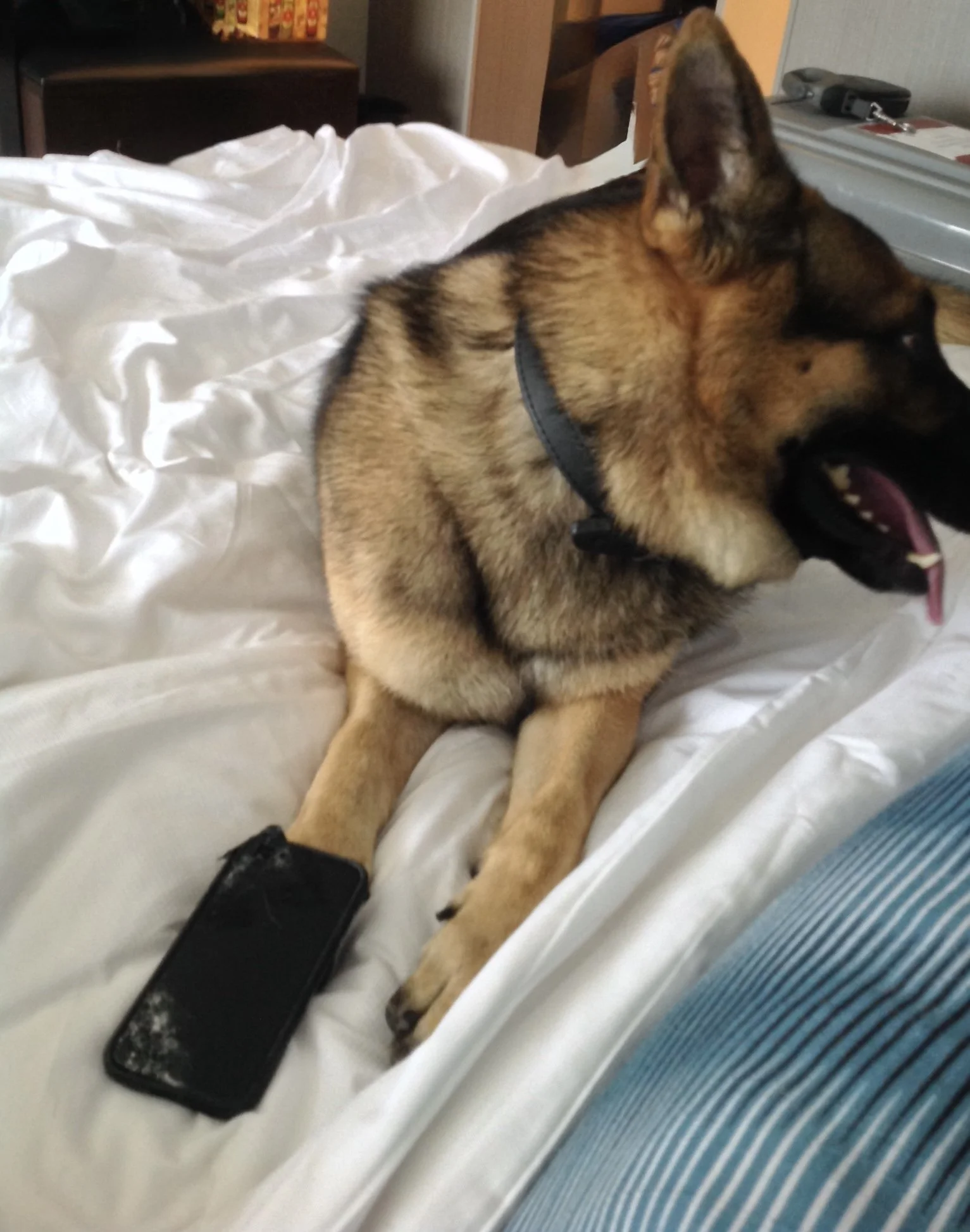
PALM BEACH, Fla. — Military Working Dog Jack V472 sits on a bed next to a chewed cellular phone at Mar-a-Lago in 2017. Jack was supporting a Secret Service mission at the time of the photo; while the dog appears to display a "guilty" expression, behavioral research by Alexandra Horowitz indicates such looks are typically submissive responses to human cues rather than a reflection of internal moral awareness. (PFC Walther/U.S. Army)
But is that really what Scruffy is thinking?
Let’s think back to Dispatch #2. There we covered the nuances of communication, especially non-verbal cues. The moment you walked in, you communicated through body language, facial expressions, and even the sharp tone of your voice that you were irritated and upset.
The reality is that Scruffy almost certainly has no clue why you are irritated. He chewed up the shoe hours ago because he was bored, he has since moved on. So, what did you just teach the dog?
The dog didn't learn that chewing shoes is "wrong." Instead, he learned that when you come home and there is an object on the floor, you become unpredictable and aggressive. That "guilty" look isn't a confession of a past wrongdoing, it's a submissive behavior meant to appease an angry pack member. He doesn't feel "bad" for the shoe, he simply recognizes that you aren’t happy and is reacting to the stress in the room.
The Science: Closing the 40-Year Gap
If you’ve followed this series, you know my stance, the gap between what science knows and what the average owner does, is forty years wide. In the dog training world, we tend to see two extremes. One side treats the dog as a furry person with a moral compass. The other treats the dog as a biological machine, a stimulus-response robot.
Both are wrong.
To truly close the gap, we have to understand that each species on this planet is unique. A dog’s emotional range can’t be judged on a human scale because—shocker—they aren’t human.
The Cognitive Gap: The Hardware Issue
To analyze dog behavior, we have to look at the hardware. Humans possess a highly developed Prefrontal Cortex (PFC), the region of the brain responsible for complex executive functions: future planning, moral reasoning, and critical analysis. In dogs, the PFC is significantly less developed. Think back to Dispatch #3.
In a scientific study in 2009, Dr. Alexandra Horowitz proved what we saw in the example above, that the "guilty look" is actually a response to the owner’s current body language, not the dog’s own past behavior. The dog is speaking a language of submission in order to appease a frustrated "pack member." They are not reflecting on a moral failing. When we project "spite" or "revenge" onto a dog, it’s not just unscientific, we are being unfair.
We are holding them accountable for a cognitive process they literally do not have the hardware to perform.
What Dogs Actually Feel: Primary vs. Secondary Emotions
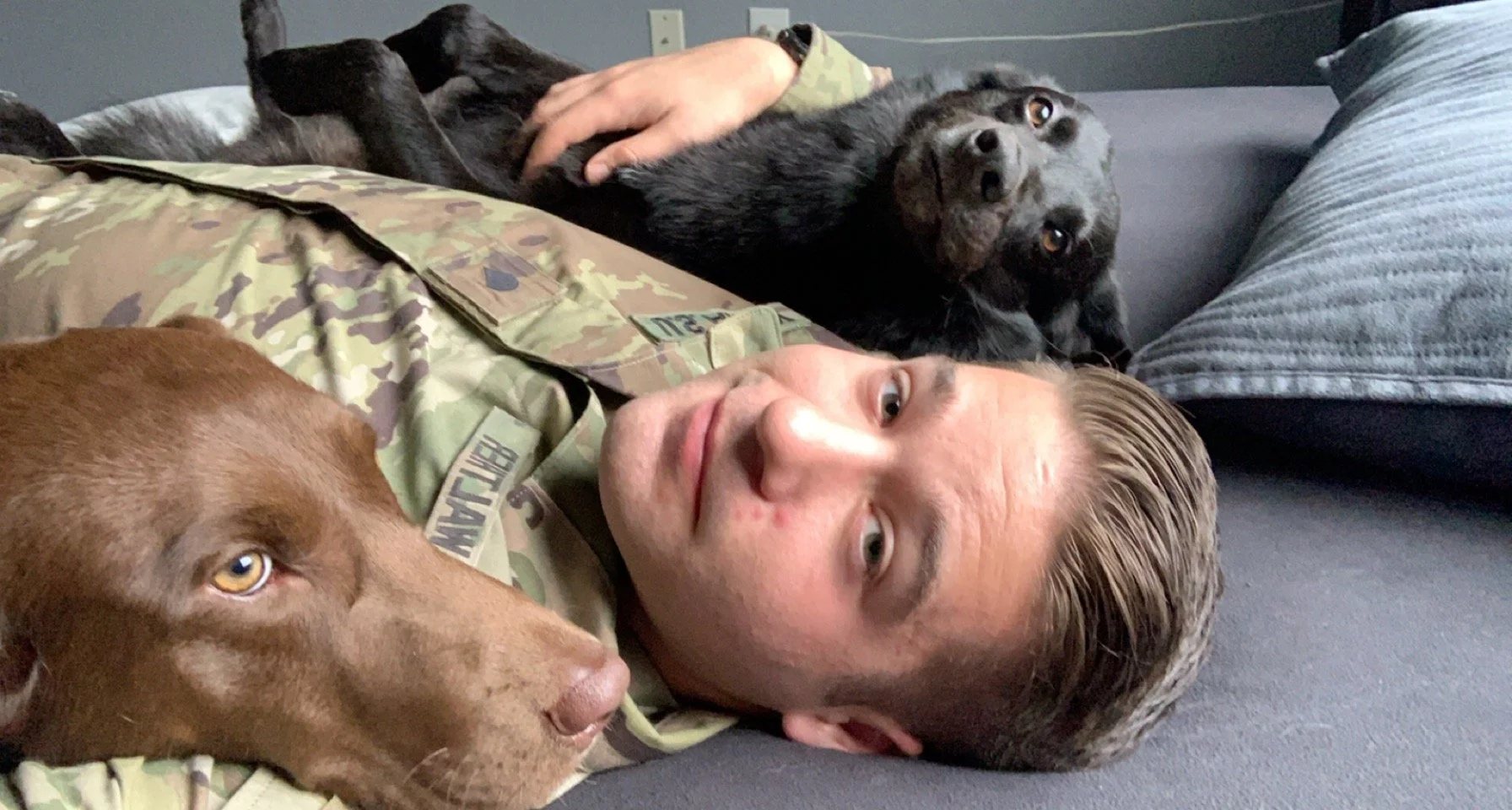
SAN ANTONIO — Dogs Lucy and Hiwa rest with Specialist Walther following his return from a workday as a Military Working Dog Course Instructor at Lackland Air Force Base in May 2021. This display of interspecies attachment reflects the research presented in Gregory S. Berns’ 2012 study, "Functional MRI in Awake Unrestrained Dogs". (Specialist Walther)
While dogs lack the brain hardware for moral "guilt," they absolutely possess a rich emotional life. Let’s distinguish between two categories:
Primary Emotions (Evolutionarily Ancient)
Joy / Happiness: Play behavior, tail-wagging, relaxed postures.
Fear: Triggered by perceived threats; results in avoidance.
Anger: Often manifested as frustration or territorial defense.
Sadness / Distress: A primary response to the disruption of a foundational social bond, manifesting as measurable physiological lethargy and searching behaviors.
Disgust: Survival emotion related to unpalatable food or scents.
Surprise: Brief reaction to unexpected stimuli.
Attachment: The deep neurological connection (oxytocin release) between dogs and humans.
Secondary Emotions (Challenged or Refined) These require a level of self-consciousness and the ability to reflect on social rules.
Guilt: Proven to be appeasement/submission in response to human anger.
Shame / Pride: No scientific evidence suggests dogs possess the "sense of self" required for these.
Jealousy: Better described as "inequity aversion"—a primitive sense of fairness.
Spite: Dogs live in the "present tense." They lack the cognitive capacity to "get back" at you for a past event.

ALLEN, Texas — Australian Shepherd Aaron lies on a porch with muddy paws after being caught playing in mud by his owner, Ramona Walther, in June 2017. While the dog appears to display a "guilty" expression, behavioral research by Alexandra Horowitz indicates such looks are typically submissive responses to human cues rather than a reflection of internal moral awareness. (Ramona Walther)
The Walther Project Way: Analyze, Apply, Achieve
To achieve the best relationship possible, we have to view the world through their biology, not ours. Here is how:
Analyze: Is your dog’s behavior a calculated choice (Human logic) or a reaction to your emotional state (Dog biology)? If your dog "refuses" a command in a crowded park, high anthropomorphism says he's being "stubborn,” or even “disrespectful.” Science says their brain is overloaded with stimuli, and their PFC isn’t conditioned enough to apply that "mental brake."
Apply: Stop the "moral" corrections. If the dog lacks the brain hardware for guilt, punishing them for a "sin" committed ten minutes ago only causes confusion and distrust. Focus on Communication instead, use markers to be as clear and consistent as possible.
Achieve: When you stop expecting your dog to think like a human, you relieve them of a burden they were never meant to carry. You stop being a judge and start being a trainer.
Closing Note
Enough thinking about what your dog "should" know and more focus on what they are actually communicating. When we strip away the human drama and the labels of "spite", “disrespect,” or "stubbornness," the path to training becomes incredibly clear. Don't waste your time looking for an apology that isn't coming. Instead, use clear, science backed communication skills to build a language of clarity and respect. When you stop treating your dog like a person, you finally give them the chance to be a great dog.
Analyze. Apply. Achieve.
Sources:
Berns, Gregory S., et al. "Functional MRI in Awake Unrestrained Dogs." PLoS ONE, vol. 7, no. 5, 2012, e38027. Gale Academic OneFile, https://doi.org/10.1371/journal.pone.0038027.
Horowitz, Alexandra. "Disambiguating the 'Guilty Look': Salient Cues to a Familiar Dog Behaviour." Behavioural Processes, vol. 81, no. 3, 2009, pp. 447-52. ScienceDirect, https://doi.org/10.1016/j.beproc.2009.03.014.